SLVK244 January 2026 TRF0213-SEP
- 1
- 2
- Trademarks
- 1Overview
- 2Single-Event Effects
- 3Test Device and Evaluation Board Information
- 4Irradiation Facility and Setup
- 5Depth, Range, and LETEFF Calculation
- 6Test Set-Up and Procedures
- 7Single-Event Latch-up (SEL) Results
- 8Single-Event Transients (SET) Results
- 9Summary
- A Total Ionizing Dose from SEE Experiments
- B References
4 Irradiation Facility and Setup
The heavy-ion species used for the SEE studies on this product were provided and delivered by the Texas A&M University (TAMU) Cyclotron Radiation Effects Facility [4], using a superconducting cyclotron and advanced electron cyclotron resonance (ECR) ion source. At the fluxes used, ion beams had good flux stability and high-irradiation uniformity over a 1in diameter circular cross-sectional area for the in-air station. Uniformity is achieved by means of magnetic defocusing. The flux of the beam is regulated over a broad range spanning several orders of magnitude. For the bulk of these studies ion fluxes between 104 and 105 ions/cm2-s were used to provide a heavy-ion fluences between 106 and 107 ions/cm2.
For these experiments Argon (40Ar), Copper (63Cu), Krypton (84Kr), and Silver (107Ag) were used. Angles were used to increment the LETEFF, details are provided in Section 5. Ion beam uniformity for all tests was in the range of 88 to 97%.
Figure 4-1 shows the TRF0213-SEP mounted on the TRF0213SEP-EVM board in front of the beam exit port, as in the heavy-ion characterization. The beam port has a 1-mil Aramica (Kevlar), 1in diameter to allow in-air testing while maintaining the vacuum in the accelerator with only minor ion energy losses. The air space between the device-under-test (DUT) and the beam exit port was set to 40mm.
The data recorded in this report was based on finalized EVM boards with optimized component values that follow datasheet recommendations.
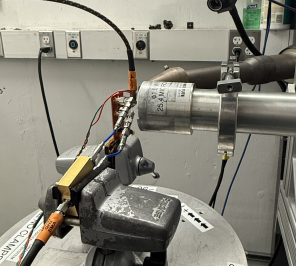 Figure 4-1 Decapped TRF0213-SEP
Evaluation Board Mounted in Front of the Heavy-Ion Beam Exit Port
Figure 4-1 Decapped TRF0213-SEP
Evaluation Board Mounted in Front of the Heavy-Ion Beam Exit Port