SBAA793 March 2026 TXG1020-Q1 , TXG1021-Q1 , TXG1041-Q1 , TXG1042-Q1 , TXG4020-Q1 , TXG4021-Q1 , TXG4041-Q1 , TXG4042-Q1 , TXG8010-Q1 , TXG8020-Q1 , TXG8021-Q1 , TXG8041-Q1 , TXG8042-Q1 , TXG8122-Q1
- 1
- Abstract
- Trademarks
- 1Introduction: The Automotive Ground Reality
- 2Automotive Ground-Level Voltage Translation (TXG) Portfolio
-
3Automotive Application Examples using TXG
Ground-Level Translators
- 3.1 Bridging Logic and Power Domains in 48V / 12V Automotive Systems
- 3.2 Simplifying Automotive Media Hub and USB Charging
- 3.3 Robust Battery Monitoring in 48V Automotive Systems
- 3.4 Simplifying Multiboard I/O Design
- 3.5 Automotive Audio Systems
- 3.6 Redundant Safety for Electrical Power Steering Subsystem
- 3.7 Robust IGBT Temperature Telemetry across Ground Domains
- 3.8 Mitigating Ground Bounce in Single-Ended Interfaces
- 3.9 Reliable Communication in ADAS Camera
- 4When to Use TXG vs. Galvanic Isolation
- 5Getting Started
- 6Summary
- 7References
3.3 Robust Battery Monitoring in 48V Automotive Systems
In 48V automotive sensing module such as HEV/EV Battery-Management System (BMS) and high-accuracy Battery Management Unit (BMU) applications, communication between the system controller and cell-stack monitoring devices often spans domains with different logic voltages and ground references. Battery stacking enables higher voltages, longer runtime and improved energy capacity for EVs. The battery monitoring ICs measure voltages, temperatures, and cell balancing states across many series cells where small ground offsets and noise can occur. The system microcontroller operates in a regulated low-voltage logic domain (for example, 3.3V), while the battery monitoring IC and associated sensing circuitry may reside in a different I/O voltage domain due to system partitioning, shunt-based current measurement, and localized grounding strategies. In this architecture, each battery monitor measures a portion of the stack. The top monitor often sits at a ground reference near half the full pack voltage (such as 48V or 24V), and is therefore referenced to a different ground than the MCU, which prevents direct communication and introduces a ground offset. Ensuring reliable communication (across I2C or UART interface) between the controller and monitor domains is critical for accurate measurement, state estimation, and safe operation of the battery stack. When the system architecture does not require full galvanic isolation between these domains, meaning the ground potential differences remain within acceptable limits and safety isolation barriers are handled elsewhere, a simpler, non-isolated solution can be used.
As shown in Figure 3-3, the TXG8041-Q1 is implemented as a multichannel logic-level translator between the system MCU and the battery monitoring devices. TXG8041-Q1 bridges these domains by translating digital interface signals—including clock, GPIO, UART/SPI, and other control lines, between the MCU supply domain and the domain of the monitor. This level shifting verifies compliant VIH/VIL thresholds, prevents I/O overstress, and maintains signal integrity in the presence of automotive noise and ground potential variation. By placing the translator at the boundary between control and measurement subsystems, the design achieves robust cross-domain communication while preserving proper ground partitioning within the 48V architecture.
Figure 3-3 shows a similar implementation using the TXG8122-Q1 for I2C interfaces between mismatched logic rails while also re-referencing the signals to the local ground of each side.
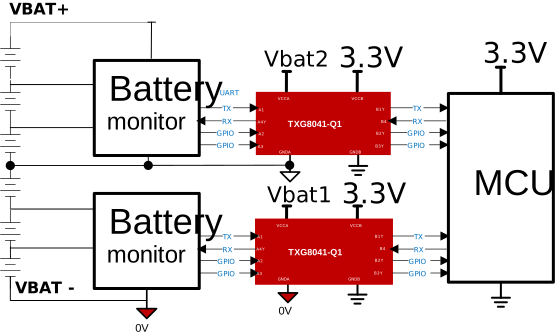 Figure 3-3 Block Diagram for Battery
Monitoring in 48V Automotive Systems using TXG8041-Q1
Figure 3-3 Block Diagram for Battery
Monitoring in 48V Automotive Systems using TXG8041-Q1 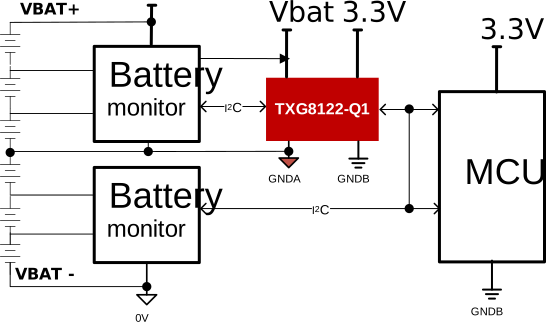 Figure 3-4 Block Diagram for Battery
Management Unit System Using TXG8122-Q1
Figure 3-4 Block Diagram for Battery
Management Unit System Using TXG8122-Q1