SBAA793 March 2026 TXG1020-Q1 , TXG1021-Q1 , TXG1041-Q1 , TXG1042-Q1 , TXG4020-Q1 , TXG4021-Q1 , TXG4041-Q1 , TXG4042-Q1 , TXG8010-Q1 , TXG8020-Q1 , TXG8021-Q1 , TXG8041-Q1 , TXG8042-Q1 , TXG8122-Q1
- 1
- Abstract
- Trademarks
- 1Introduction: The Automotive Ground Reality
- 2Automotive Ground-Level Voltage Translation (TXG) Portfolio
-
3Automotive Application Examples using TXG
Ground-Level Translators
- 3.1 Bridging Logic and Power Domains in 48V / 12V Automotive Systems
- 3.2 Simplifying Automotive Media Hub and USB Charging
- 3.3 Robust Battery Monitoring in 48V Automotive Systems
- 3.4 Simplifying Multiboard I/O Design
- 3.5 Automotive Audio Systems
- 3.6 Redundant Safety for Electrical Power Steering Subsystem
- 3.7 Robust IGBT Temperature Telemetry across Ground Domains
- 3.8 Mitigating Ground Bounce in Single-Ended Interfaces
- 3.9 Reliable Communication in ADAS Camera
- 4When to Use TXG vs. Galvanic Isolation
- 5Getting Started
- 6Summary
- 7References
3.5 Automotive Audio Systems
In automotive audio amplifier and mixed-signal systems with precision analog components, Class-D amplifiers and high-speed data converters often introduce switching noise, ground bounce, and AC ground disturbances resulting in a noisy or unstable ground that can corrupt low-voltage digital interfaces and cause signal integrity issues between systems. Noise that carries to the audio converter (ADC/DAC) ground can introduce fluctuations in the reference voltage, leading to degraded performance, or distorted recording and playback.
Intentional ground shift can also be required for the negative rail in class D audio amplifiers to increase the total voltage swing available to the amplifier output to deliver higher power to the speaker for louder and cleaner audio playback. The TXG ground-level translators provide robust signal integrity by maintaining consistent logic thresholds and isolating sensitive control signals from noisy ground domains. As shown in Figure 3-6, the TXG8122-Q1 is used to isolate the MCU control signals on I2C bus from audio circuitry and TXG4041-Q1 is used to isolate the audio data bus returning to the controller. The TXG device is also used to bridge the offset between the application SoC which sits on 0V ground and the Class-D power stage which sits on ±2.5V.
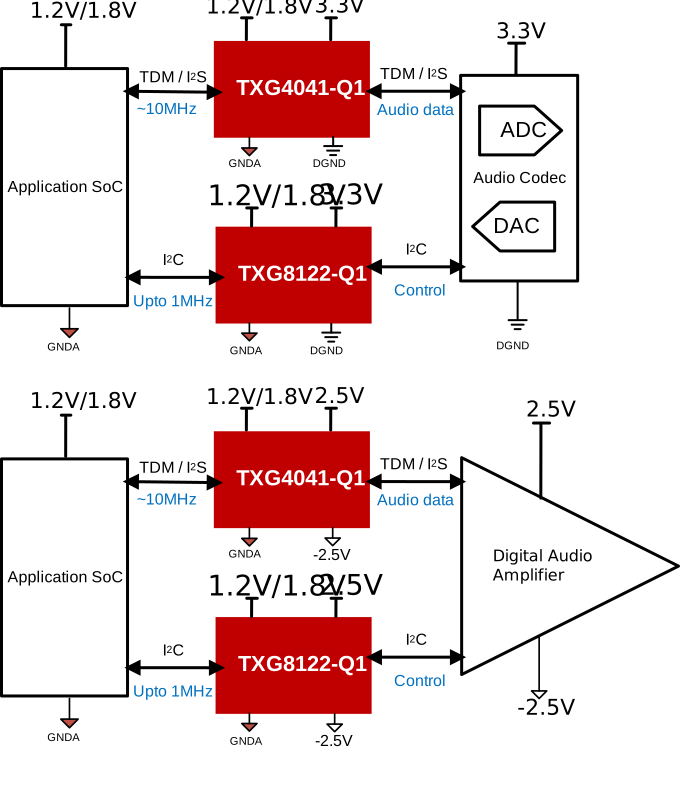 Figure 3-6 Block Diagram for Automotive
Audio Systems Using TXG8122-Q1 and TXG4041-Q1
Figure 3-6 Block Diagram for Automotive
Audio Systems Using TXG8122-Q1 and TXG4041-Q1