SBAA793 March 2026 TXG1020-Q1 , TXG1021-Q1 , TXG1041-Q1 , TXG1042-Q1 , TXG4020-Q1 , TXG4021-Q1 , TXG4041-Q1 , TXG4042-Q1 , TXG8010-Q1 , TXG8020-Q1 , TXG8021-Q1 , TXG8041-Q1 , TXG8042-Q1 , TXG8122-Q1
- 1
- Abstract
- Trademarks
- 1Introduction: The Automotive Ground Reality
- 2Automotive Ground-Level Voltage Translation (TXG) Portfolio
-
3Automotive Application Examples using TXG
Ground-Level Translators
- 3.1 Bridging Logic and Power Domains in 48V / 12V Automotive Systems
- 3.2 Simplifying Automotive Media Hub and USB Charging
- 3.3 Robust Battery Monitoring in 48V Automotive Systems
- 3.4 Simplifying Multiboard I/O Design
- 3.5 Automotive Audio Systems
- 3.6 Redundant Safety for Electrical Power Steering Subsystem
- 3.7 Robust IGBT Temperature Telemetry across Ground Domains
- 3.8 Mitigating Ground Bounce in Single-Ended Interfaces
- 3.9 Reliable Communication in ADAS Camera
- 4When to Use TXG vs. Galvanic Isolation
- 5Getting Started
- 6Summary
- 7References
3.9 Reliable Communication in ADAS Camera
In an ADAS Automotive Camera, the main processor or safety MCU commonly operates from a 5V logic domain, while the serializer/deserializer (SerDes) device typically uses a 3.3V I/O rail. In distributed camera architectures, the MCU and SerDes can also reside on different ground regions, as the SerDes is often positioned closer to the image sensor and high-speed link circuitry. Ground shifts caused by cable return currents, EMI, and high-speed switching activity can reduce noise margin on low-speed control interfaces such as I2C used for configuration, diagnostics, and status monitoring.
The TXG8122-Q1 is inserted between the MCU and SerDes to provide bidirectional I2C voltage translation and ground-domain re-referencing as shown in Figure 3-10. By connecting VCCA to the 5V MCU domain and VCCB to the 3.3V SerDes domain, the device maintains compliant SDA and SCL logic thresholds while tolerating moderate ground offsets between GNDA and GNDB. This approach enables robust cross-domain communication without requiring galvanic isolation, improving system reliability while simplifying the multivoltage power architecture of the ADAS camera module.
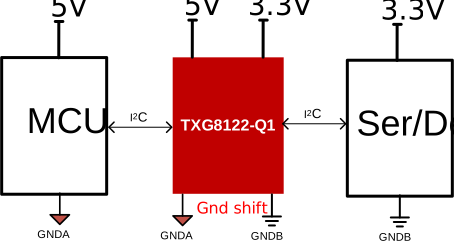 Figure 3-10 Block Diagram for ADAS Camera
System Using TXG8122-Q1
Figure 3-10 Block Diagram for ADAS Camera
System Using TXG8122-Q1