SLVAFX0B October 2024 – March 2026 TLV702 , TLV703 , TLV755P , TPS74401 , TPS7A13 , TPS7A14 , TPS7A20 , TPS7A21 , TPS7A49 , TPS7A52 , TPS7A53 , TPS7A53B , TPS7A54 , TPS7A57 , TPS7A74 , TPS7A83A , TPS7A84A , TPS7A85A , TPS7A91 , TPS7A92 , TPS7A94 , TPS7A96 , TPS7H1111-SP
- 1
- Abstract
- Trademarks
- 1Introduction to Linear Regulator Turn-On Time
-
2What Impacts the LDO Rise Time?
- 2.1
Simple Use Cases
- 2.1.1 Case 1: LDO With an NR Filter But Without CFF Capacitance
- 2.1.2 Case 2: NR Filter With a CFF Capacitance
- 2.1.3 Fast-Charge Circuitry
- 2.1.4
Non-Preferred LDO Behavior
- 2.1.4.1 Applied Voltage Bias
- 2.1.4.2 Fast Charge Current Tolerance
- 2.1.4.3 Internal Error Amplifier Offset Voltage
- 2.1.4.4 Temperature Impacts the Fast-Charge Current Source
- 2.1.4.5 Error Amplifier Common Mode Voltage
- 2.1.4.6 Reference Voltage (VREF) Ramp Time Dominates the Turn-On Time
- 2.1.4.7 Start-Up During Dropout Mode
- 2.1.4.8 Large Values of COUT Induce Internal Current Limit
- 2.1.4.9 Limitations of Large-Signal LDO Bandwidth
- 2.2 Specific Use Cases and Examples
- 2.1
Simple Use Cases
- 3System Considerations
- 4Summary
- 5Conclusion
- 6References
3.2 Inrush Current Analysis
We can use the previous equations to quickly calculate the inrush current through the LDO regulator if we know the output capacitance and load during the turn-on period. Figure 3-3 provides an example using the TPS7A20 (recall that this device includes an NR filter that also controls the turn-on time). Two 1μF capacitors are installed on the output which provide an effective capacitance of 1.4μF.
Figure 3-3 provides an example using the TPS7A84A. Recall that the TPS7A84A uses a fast-charge current source (without an NR resistor in parallel) and switches in the NR filter for steady state operation. The analysis used COUT = 67μF and the peak current (IPEAK) is well within the tolerance of the capacitors.
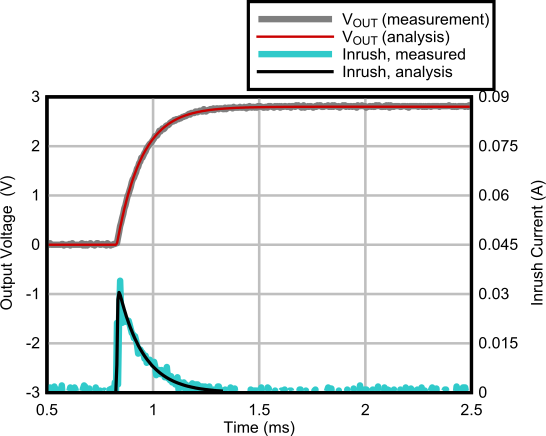
| TPS7A20 | COUT = 1μF || 1μF |
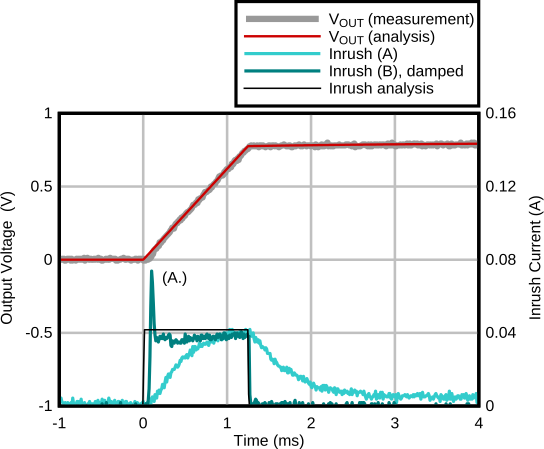
| TPS7A84A | COUT = 47μF || 10μF || 10μF |
| (A.) VCM induced current spike | |