SFFS216 January 2026 TPS22919-Q1
4 Pin Failure Mode Analysis (Pin FMA)
This section provides a failure mode analysis (FMA) for the pins of the TPS22919-Q1. The failure modes covered in this document include the typical pin-by-pin failure scenarios:
- Pin short-circuited to ground (see Table 4-3)
- Pin open-circuited (see Table 4-4)
- Pin short-circuited to an adjacent pin (see Table 4-5)
- Pin short-circuited to supply (see Table 4-6)
Table 4-3 through Table 4-6 also indicate how these pin conditions can affect the device as per the failure effects classification in Table 4-1.
| Class | Failure Effects |
|---|---|
| A | Potential device damage that affects functionality. |
| B | No device damage, but loss of functionality. |
| C | No device damage, but performance degradation. |
| D | No device damage, no impact to functionality or performance. |
Figure 4-1 shows the TPS22919-Q1 pin diagram. For a detailed description of the device pins please refer to the Pin Configuration and Functions section in the TPS22919-Q1 datasheet.
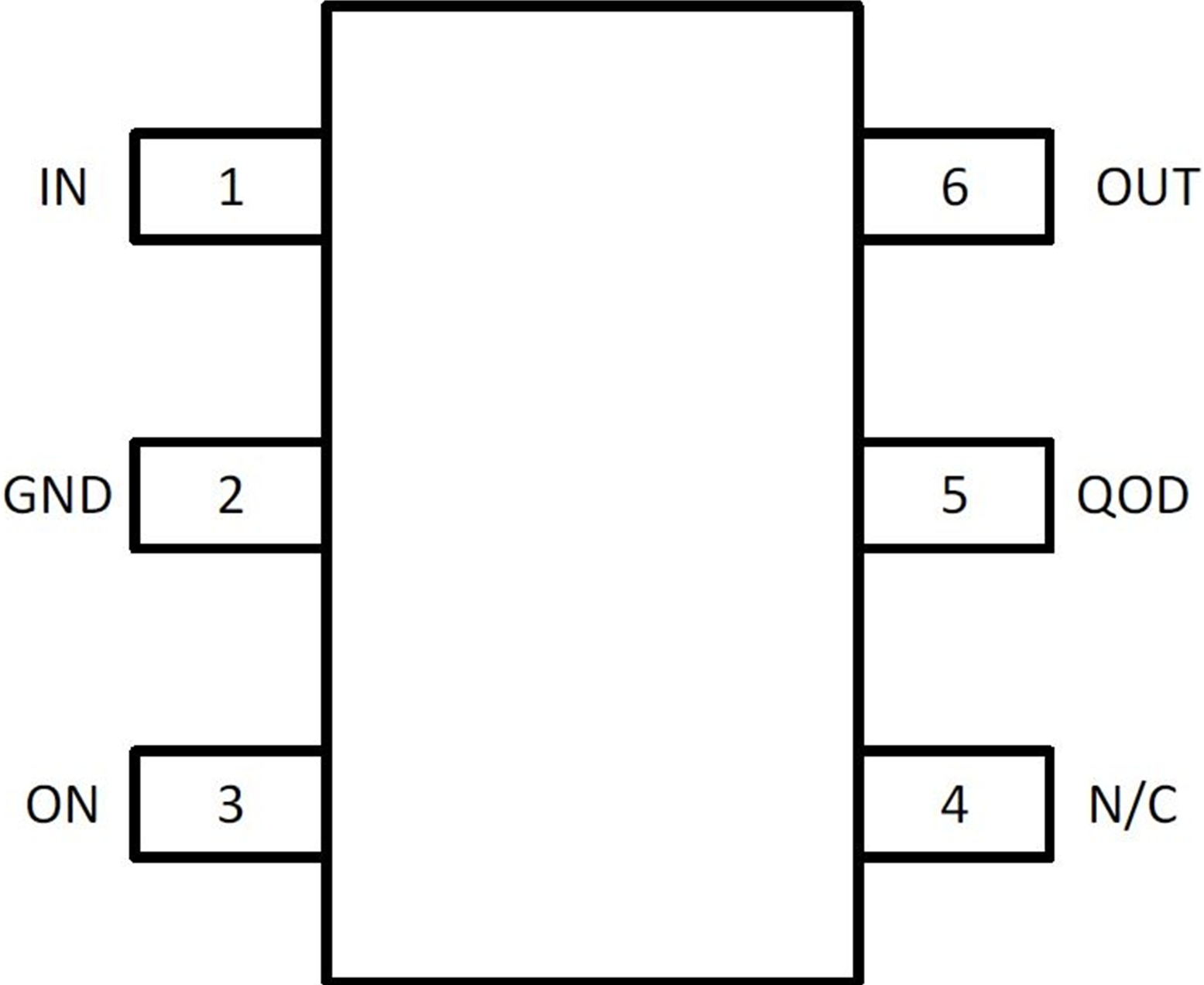 Figure 4-1 Pin Diagram
| PIN | I/O | DESCRIPTION | |
|---|---|---|---|
| NO. | NAME | ||
| 1 | IN | I | Switch input. |
| 2 | GND | — | Device ground. |
| 3 | ON | I | Active high switch control input. Do not leave floating. |
| 4 | NC | — | No connect pin, leave floating. |
| 5 | QOD | O | Quick Output Discharge pin. This functionality can be enabled in
one of three ways.
|
| 6 | OUT | O | Switch output. |
Following are the assumptions of use and the device configuration assumed for the pin FMA in this section:
- The absolute maximum ratings for the device are not exceeded.
| Pin Name | Pin No. | Description of Potential Failure Effects | Failure Effect Class |
|---|---|---|---|
| IN | 1 | The power supply is shorted. | D |
| GND | 2 | This is the GND pin. The device operates as normal. | D |
| ON | 3 | The device is disabled. | D |
| NC | 4 | This is the no connect pin. There is no effect on the normal operations of the device. | D |
| QOD | 5 | If the QOD pin is left floating in the application, short to ground has no effect. If the QOD pin is connected to the OUT pin, the device limits the output current and thermally cycles until the short to ground is removed. | D |
| OUT | 6 | The device limits the output current and thermally cycles until the short to ground is removed. | D |
| Pin Name | Pin No. | Description of Potential Failure Effects | Failure Effect Class |
|---|---|---|---|
| IN | 1 | There is no power supply to the device. The device does not pass through voltage to the OUT pin. | D |
| GND | 2 | There is no GND connection to the device. The device is not functional. | B |
| ON | 3 | The ON pin potentially floats high or low, the output state is unknown. | B |
| NC | 4 | This is the no connect pin. There is no effect on the normal operations of the device. | D |
| QOD | 5 | If the QOD pin is left floating in the application, open-circuit has no effect. If the QOD pin is connected to the OUT pin, the device no longer has quick output discharge functionality. | D |
| B | |||
| OUT | 6 | The output does not deliver the voltage to the load. | D |
| Pin Name | Pin No. | Shorted to | Description of Potential Failure Effects | Failure Effect Class |
|---|---|---|---|---|
| IN | 1 | GND | The power supply is shorted. | D |
| GND | 2 | ON | The device is disabled. | D |
| NC | 4 | QOD | There is no effect on the normal operations of the device. | D |
| QOD | 5 | OUT | If the QOD pin is left floating in the application, the condition adds quick output discharge functionality. If the QOD pin is connected to the OUT pin, the device functions as expected. | B |
| D |
| Pin Name | Pin No. | Description of Potential Failure Effects | Failure Effect Class |
|---|---|---|---|
| IN | 1 | The device operates normally, as expected. | D |
| GND | 2 | The power supply is shorted. | D |
| ON | 3 | The device is enabled if the power supply is above the ON threshold (VIH). | D |
| NC | 4 | This is the no connect pin. There is no effect on the normal operations of the device. | D |
| QOD | 5 | If the QOD pin is left floating in the application, this condition has no functional effect. If the QOD pin is connected to the OUT pin, the power MOSFET is shorted, and disabling the device no longer blocks power to the OUT pin. | D |
| B | |||
| OUT | 6 | The power MOSFET is shorted. Disabling the device no longer blocks power to the OUT pin. | B |