SBAA735 March 2026 TAS2120 , TAS2320 , TAS2780 , TAS2781 , TAS3251 , TAS5802 , TAS5805M , TAS5815 , TAS5825M , TAS5825P , TAS5827 , TAS5828M , TAS5830 , TAS6684-Q1 , TPA3221 , TPA3223 , TPA3250 , TPA3251 , TPA3255

Introduction
Design high-quality speakers, TVs, and soundbars with best-in-class audio amplifiers from Texas Instruments (TI). The amplifiers offer a wide range of advanced features and capabilities to enhance the overall listening experience. TI's Class-D amplifiers offer exceptional power density, efficiency, and thermal performance, making them an excellent choice for applications where space is limited or thermal management is critical. In this document you will find advanced features being used in everyday speakers, TVs, and soundbars enabling end customers a more immersive audio experience. See Table 1 for Audio Device Recommendations.
TI's Class-D amplifiers enable designers to:
- Improve system efficiency and reduce power consumption
- Minimize board space and thermal footprint
- Enhance reliability and extend product lifespan through advanced protection features
- Achieve higher audio fidelity with reduced distortion
Y-Bridge Architecture
Traditional audio amplifier architectures rely on a single high-voltage supply rail (PVDD) for output stage switching and amplification, alongside a low-voltage rail for I/Os and LDOs. However, during idle periods— when no audio signal is present—amplifiers continue to switch, resulting in poor power efficiency. Because the switching occurs exclusively on the high-voltage rail, the excess voltage headroom leads to idle efficiencies falling below 20%. To overcome this limitation, Texas Instruments introduced the Y-Bridge power architecture. Figure 1 shows the intelligent design which allows the amplifier to seamlessly alternate between two supply rails based on the output power demand. By optimizing the supply voltage in real time, the Y-bridge architecture significantly reduces idle power consumption—by up to 90%—and improves efficiency by 15% to 20% at lower output levels, all without compromising audio performance. See also TI's Y-Bridge in TAS278x Class-D Amplifiers for Improving Efficiency application note for more detailed information.
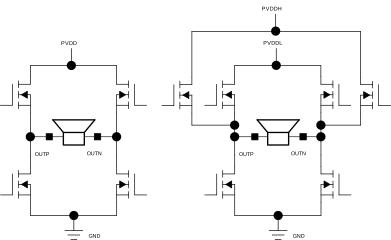 Figure 1 Traditional Class-D Amplifier
vs Simplified Y-Bridge Architecture
Figure 1 Traditional Class-D Amplifier
vs Simplified Y-Bridge ArchitectureClass-H Architecture
Figure 2 and Figure 3 show how Class-H control dynamically adjusts the supply voltage (PVDD) based on the audio signal. When the signal is small, PVDD is low, reducing power dissipation. When the signal is large, PVDD is increased to provide the necessary headroom without overstressing the switching devices. By minimizing the voltage difference between the supply and the instantaneous signal level, Class-H significantly reduces switching losses within the output stage, improving overall efficiency.
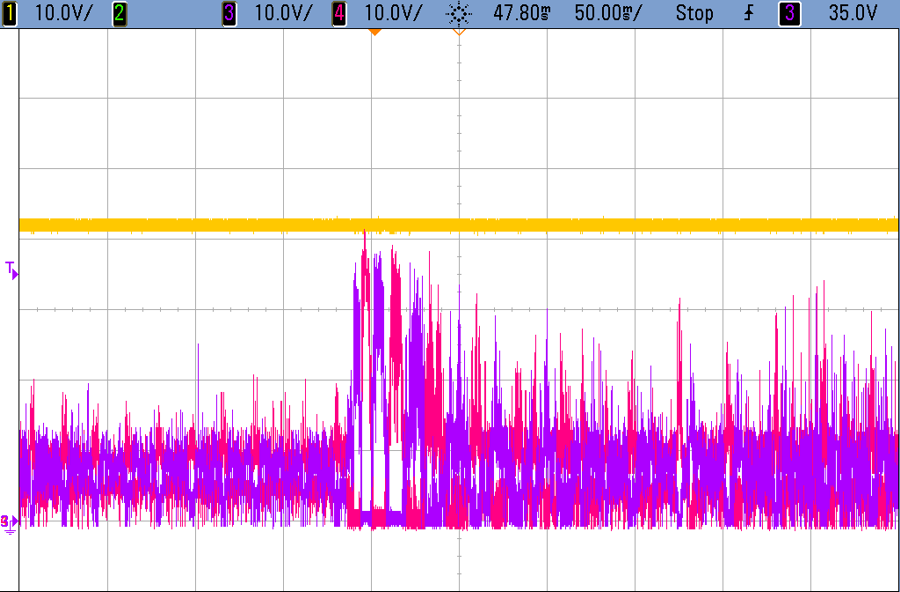 Figure 2 Audio Output and Boost
Voltage Without Class-H Operation
Figure 2 Audio Output and Boost
Voltage Without Class-H Operation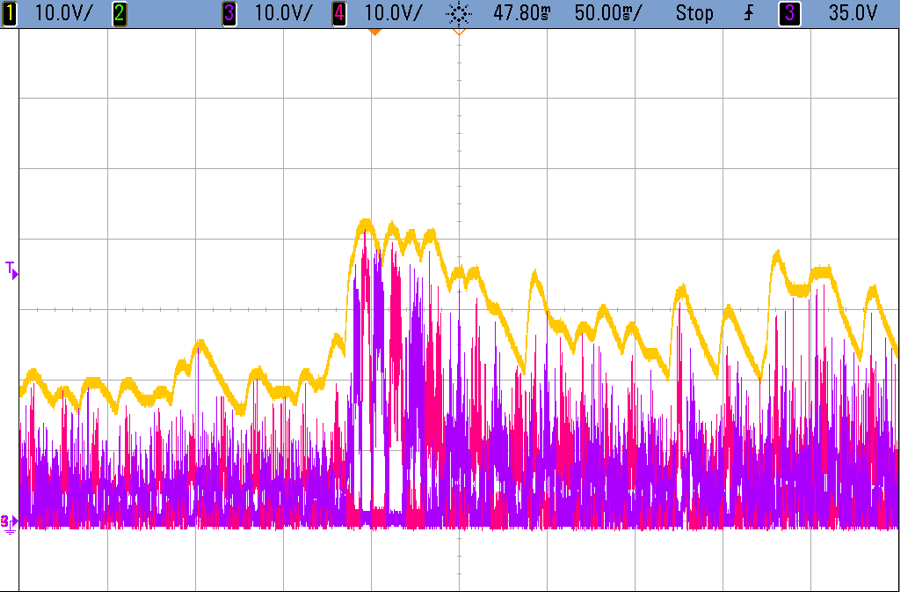 Figure 3 Audio Output and Boost
Voltage With Class-H Operation
Figure 3 Audio Output and Boost
Voltage With Class-H OperationPVDD Sensing
PVDD sensing uses an 8-bit PVDD supply voltage ADC to track the PVDD and dynamically adjust the gain if needed. This feature is quite useful in the following scenarios:
- Customers have the volume turned up too high.
- PVDD voltage drops due to battery discharging but the input signal amplitude stays the same.
The PVDD sensing has two functional modes, depending on the measured value of supply voltage (PVDD).
- Mode 1: If PVDD voltage is greater than maximum peak output voltage (MPOV), no action is taken by the PVDD sensing circuit since there is still sufficient headroom for the amplifier to reproduce the audio signals up to 0dBFS.
- Mode 2: If PVDD voltage is less than MPOV, the PVDD sensing circuit reduces gain to make sure that signals can fit within the available PVDD voltage to avoid clipping.
Thermal Foldback
Thermal foldback is a power limiting feature (a type of thermal protection). The prime purpose of foldback power limiting is to keep the output stage within a safe power dissipation limit to avoid unexpected overtemperature shutdown (OTSD).
The audio DSP core uses the thermal foldback feature to monitor junction temperature continuously in real-time to provide safe operations. As the junction temperature rises above the threshold set by operating threshold warmup (OTW), the thermal foldback circuit initially activates. This scenario provides a smooth audio response and allows for uninterrupted music playback when OTW limits are crossed. That means the device simply does not shut down but continues to operate with considerable music output power to avoid triggering OTSD. See the TAS5825 Advanced Features application note for more details on Thermal foldback.
Cycle-by-Cycle (CBC)
Cycle-by-cycle (CBC) current limit is a protection feature that prevents the output current from exceeding a specific threshold during each PWM pulse. When the current hits the limit, the device limits the current for that cycle and continues operation without triggering a fault. This allows the device to handle large peak currents in short durations and continue operation without audio disruption by limiting the music signal peak power. This feature has many configurable options based on the desired result, there are registers you can toggle to enable faults and warnings or limit the overcurrent threshold by a percentage.
Table 1 shows the different audio device recommendations.
| Specifications | TAS2120 | TAS2320 | TAS5802 | TAS5805M | TAS5815 | TAS5822M | TAS5825M | TAS5825P | TAS5827 | TAS5828M | TAS5830 |
|---|---|---|---|---|---|---|---|---|---|---|---|
| PVDD | 2.5V–15V | 2.5V–15V | 4.5V–20V | 4.5V–26.4V | 4.5V–26.4V | 4.5V–26.4V | 4.5V–26.4V | 4.5V–26.4V | 4.5V–26.4V | 4.5V–26.4V | 4.5V–30V |
| Boost Voltage | 15V | N/A | N/A | N/A | N/A | N/A | N/A | N/A | N/A | N/A | N/A |
| Output Power | 1 × 8.4W | 1 × 15W | 2 × 22W | 2 × 23W | 2 × 30W | 2 × 35W | 2 × 38W | 2 × 38W | 2 × 43W | 2 × 50W | 2 × 60W |
| Peak Current | 5.1A (Boost) | 4.1A | 5A | 5A | 6.5A | 7A | 7.5A | 7.5A | 8A | 8A | 8A |
| RDS(on) | 350m? | 350m? | 120m? | 180m? | 120m? | 90m? | 90m? | 90m? | 70m? | 90m? | 70m? |
| Y-Bridge | ? | ? | |||||||||
| Class-H | ? | ? | ? | ? | ? | ? | ? | ||||
| PVDD Sensing | ? | ? | ? | ? | ? | ||||||
| Thermal Foldback |
? | ? | ? | ? | ? | ? | |||||
| CBC | ? | ? | ? | ||||||||
| Package | 26-QFN | 26-QFN | 28-PWP | 28-PWP | 28-PWP | 38-PWP | 32-QFN | 32-QFN | 32-QFN | 32-DAD (Pad up) | 32-DAD (Pad up) |
| Package Size | 4mm × 3.5mm | 4mm × 3.5mm | 9.7mm × 6.4mm | 9.7mm × 6.4mm | 9.7mm × 6.4mm | 9.7mm × 4.4mm | 5mm × 5mm | 5mm × 5mm | 5mm × 5mm | 11mm × 6.2mm | 11mm × 6.2mm |